
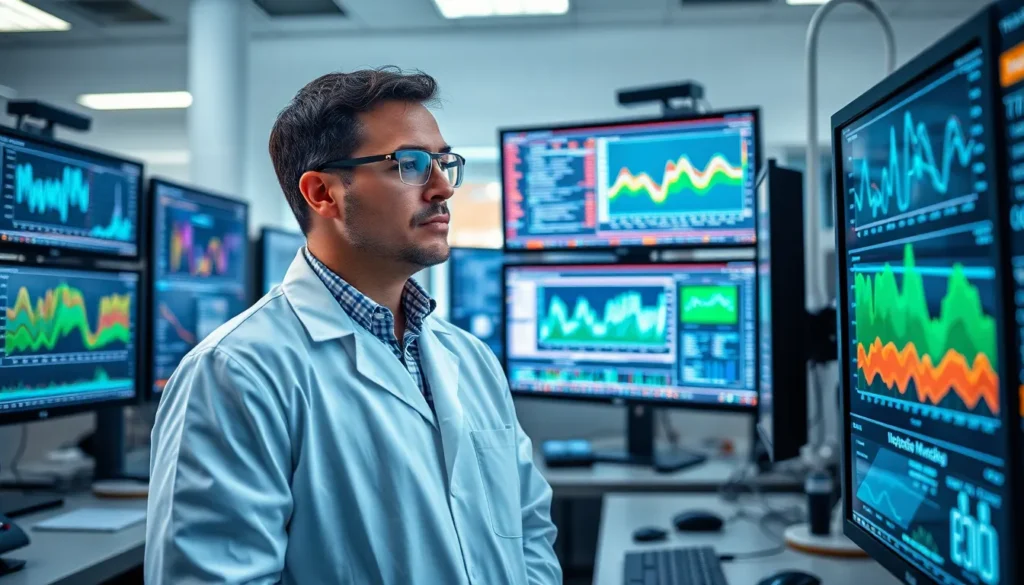
Imagine being able to step into a time machine without the need for flux capacitors or DeLoreans. Temporal simulation offers just that—a fascinating glimpse into how time can be manipulated and understood. It’s not just for sci-fi nerds anymore; scientists and tech enthusiasts are harnessing this concept to predict future events, analyze past decisions, and even improve our daily lives.
Overview of Temporal Simulation
Temporal simulation involves understanding and manipulating time to analyze scenarios. This concept offers a framework for predicting future events and assessing past decisions.
Definition and Importance
Temporal simulation refers to the process of modeling events over time to observe their impacts. This approach enhances decision-making by providing insights into how choices affect future outcomes. Understanding temporal simulation aids in grasping complex interactions within systems. By simulating various temporal scenarios, researchers can identify trends and anticipate consequences. This capability is vital for fields like climate science, economics, and urban planning. The ability to visualize time-related dynamics fosters knowledge and informs effective strategies.
Applications in Various Fields
Temporal simulation finds application across numerous disciplines. In healthcare, it supports patient treatment plans by predicting recovery trajectories. Economists utilize it to forecast market trends and assess policy impacts. Engineers apply temporal simulation in project management to optimize schedules and resources. Environmental scientists employ it for climate modeling, analyzing potential future scenarios based on current data. Similarly, educators integrate temporal simulation in curricula to illustrate historical events and their ramifications. These applications illustrate the versatility and utility of temporal simulation in diverse contexts.
Methodologies in Temporal Simulation

Temporal simulation employs several methodologies to effectively model and predict temporal events across various contexts. Each methodology offers unique advantages for specific applications.
Discrete Event Simulation
Discrete event simulation focuses on specific points in time where changes occur. This approach models systems as a series of distinct events. For example, it captures changes in a queue at a service center or the progression of tasks in a project. Analysts often use this technique in logistics and manufacturing, where precise timing and resource allocation are crucial. By simulating events, planners gain insights into system performance and can optimize operations. The ability to assess different scenarios also aids in improving resource utilization and reducing costs effectively.
Continuous Time Simulation
Continuous time simulation, in contrast, models processes that evolve over continuous time intervals. This technique allows for examining systems where changes occur constantly rather than at fixed points. Fields such as climate modeling and chemical engineering frequently leverage this approach. It helps in understanding how variables affect one another over time, providing a comprehensive view of system dynamics. Continuous time simulation enables researchers to analyze gradual shifts, predict future states, and explore complex interactions within systems efficiently. This comprehensive modeling fosters informed decision-making across various disciplines.
Challenges in Temporal Simulation
Temporal simulation encounters various challenges that can hinder its effectiveness. Addressing these challenges is crucial for advancing the field and harnessing its full potential.
Data Accuracy and Reliability
Data accuracy plays a vital role in temporal simulation. Inaccurate data can lead to misleading results and poor decisions. Reliable data sources must be established to ensure the credibility of simulations. Analysts should implement rigorous validation techniques to assess data quality. Different fields present unique data challenges, affecting the simulation’s outcome. For instance, predicting healthcare recovery requires high-quality patient data, while economic forecasting depends on reliable market indicators. Ensuring consistent data standards enhances the robustness of the simulation models used in various disciplines.
Computational Complexity
Computational complexity presents a significant hurdle in temporal simulation. Simulations often demand extensive computational resources, especially when modeling complex systems with numerous variables. As models grow more intricate, the processing time increases, which can impede real-time analysis. Simplifying models without sacrificing accuracy becomes a critical goal. Techniques such as parallel processing can help alleviate computational burdens. Moreover, efficient algorithms contribute to optimizing performance, allowing for more rapid simulations. Addressing these complexities fosters enhanced modeling capabilities and improves the feasibility of deploying temporal simulations across various applications.
Future Trends in Temporal Simulation
Emerging trends in temporal simulation signal a transformative shift in how various fields utilize this innovative approach. Scientists and engineers are increasingly leveraging advanced technologies to enhance simulation capabilities.
Advances in Technology
Artificial intelligence and machine learning play critical roles in improving the efficiency of temporal simulations. These technologies help process vast amounts of data quickly, enabling real-time decision-making in domains like healthcare and finance. Cloud computing also contributes by providing scalable resources, allowing researchers to run complex models without hindrance. Enhanced visualization tools facilitate a clearer understanding of simulation outcomes, fostering better communication among stakeholders. Overall, these technological advancements are making temporal simulation more accessible and effective.
Potential Applications and Innovations
Innovative applications of temporal simulation continue to expand across various sectors. In urban planning, simulations assist in forecasting the impacts of infrastructure changes over time, helping optimize resource allocation. Transportation systems can use predictive models to enhance traffic management and reduce congestion. In finance, temporal simulation aids in creating accurate market predictions and risk assessments. The healthcare sector benefits through personalized medicine, where simulations help tailor treatments based on predicted recovery trajectories. As these applications grow, more industries will likely embrace temporal simulation for strategic planning and decision-making.
Temporal simulation is reshaping how professionals approach complex systems and decision-making. Its ability to model events over time offers invaluable insights across various fields. By harnessing advanced technologies like AI and cloud computing, the potential for real-time applications continues to expand.
As industries increasingly adopt these methodologies, the importance of accurate data and efficient computational strategies cannot be overstated. The ongoing evolution of temporal simulation promises to enhance strategic planning and improve outcomes in healthcare, urban planning, and beyond. Embracing this innovative approach will not only facilitate better decision-making but also pave the way for a deeper understanding of the intricate dynamics of time.